Skip to content
ANANTATECH HUB

Manufacturing and Industrial

Connected Technology for Modern Manufacturing

Two products meet manufacturing here. Easy Khata runs the business around production today — sales, purchase, inventory, accounts, GST and people on one set of records. MANUPRIME is the manufacturing ERP built to run production itself: planning, work orders, shop floor, quality and costing. It has its own site and is marked Coming Soon on this one until it is released.

Also covers: Production · Factory · Plant · Industrial Manufacturing · OEM

About this industry

Manufacturing adds a conversion step that ordinary trading businesses do not have. Material comes in, changes form through a sequence of operations, and leaves as something worth more — or worth less, if yield and quality were not controlled. Every other part of the business, from purchasing to costing to delivery commitments, depends on knowing what is happening in that conversion.

Common operational problems

  • Production is planned without confirming material and capacity are actually available
  • Cost per unit is only known long after the product was quoted and sold
  • Work in progress between operations cannot be quantified
  • Job work sent outside is not reconciled against wastage norms
  • Quality problems reach the customer because inspection is informal
  • A batch complaint cannot be traced back to its raw material source

Example workflows

  1. Sales order exploded through BOM into material requirements

  2. Shortfall raised as purchase requirement against current stock

  3. Work order scheduled against line and machine capacity

  4. Material issued, consumption recorded, WIP tracked between stages

  5. Inspection at incoming, in-process and final stages

  6. Dispatch with challan, e-Invoice and e-Way Bill

Needs no product covers yet

On Request

Where a ready product does not reach far enough, these are the needs this industry raises most often. We do not build to order; telling us which of these you need is what shapes what we build next.

  • Machine and PLC data capture for output and downtime
  • Shop-floor terminals for operator entry
  • Customer-specific quality certificate formats
  • Supplier portal for purchase orders and dispatch confirmation

Common operational challenges

The problems that recur across manufacturers, whatever they make.

Production plans that ignore material reality

A schedule is committed before anyone checks whether the material to build it is actually in stock, so runs stop halfway and delivery dates slip.

Cost per unit discovered months later

Material, labour and overhead are only assembled at year-end, by which point loss-making products have been quoted at the same price all year.

WIP that nobody can quantify

Material has left the store but not arrived as finished goods. How much is sitting between stages, and in what state, is a matter of opinion.

Job work that leaks

Material goes out to a job worker and less comes back than expected. Without issue-and-receipt reconciliation, the shortfall is absorbed silently.

Quality problems found by the customer

Without inspection at incoming, in-process and final stages, defects are discovered after dispatch when they cost the most to fix.

No traceability when it is needed most

A customer complaint about one batch cannot be traced back to its raw material source, so the response is either a total recall or a guess.

Manufacturing modules

Every module carries an explicit status. These are deliberately conservative pending verification — they understate rather than overstate what is live. Ask us about your specific requirement and we will confirm the current position directly.

Manufacturing ERP

On Request

Sales, purchasing, inventory, production, finance, GST and HR running on one connected set of records.

  • Connected sales and purchase against production demand
  • Shared inventory across raw material, WIP and finished goods
  • Finance and GST on the same transactions
  • Workforce records tied to production activity
Request this module

Product and BOM

On Request

Multi-level bills of material with versioning, so a design change does not silently break costing.

  • Multi-level BOM structures
  • BOM versions and effective dates
  • Routing and operation sequence
  • Wastage and yield norms per item
Request this module

Production Planning

On Request

Turning committed orders into a schedule that accounts for material and capacity you actually have.

  • Demand planning from orders and forecasts
  • Material requirement calculation against stock
  • Capacity assessment by line or machine
  • Production schedules with dates
Request this module

Work Orders

On Request

The instruction to make something, with an owner and a tracked state.

  • Work-order creation from a plan or order
  • Assignment to line, machine or team
  • Progress recording against the order
  • Completion and closure with output quantity
Request this module

Shop-Floor Management

On Request

What is actually happening on the floor right now, rather than at the end of the shift.

  • Live production status by station
  • WIP position between stages
  • Machine allocation and utilisation
  • Output and rejection capture at source
Request this module

Inventory and Warehouse

On Request

Stock held in three states — raw material, work in progress and finished goods — across locations.

  • Raw material, WIP and finished-goods segregation
  • Batch and lot control
  • Serial-number tracking
  • Barcode-driven movement
  • Multi-warehouse and inter-location transfers
Request this module

Procurement

On Request

Buying driven by production requirement instead of by memory.

  • Purchase requirements generated from production plans
  • Vendor comparison against quotations
  • Purchase orders and acknowledgements
  • Goods receipt with inspection
  • Supplier performance on quality and delivery
Request this module

Quality Management

On Request

Inspection at the three points where a defect is cheapest to catch.

  • Incoming material inspection
  • In-process quality checks
  • Final inspection before dispatch
  • Defect recording with reason codes
  • Corrective and preventive action tracking
  • Quality certificates for customers
Request this module

Job Work

On Request

Material sent out for processing and received back, with wastage and charges accounted for.

  • Material issue to a job worker
  • Subcontract order tracking
  • Receipt of processed material
  • Wastage and shortage reconciliation
  • Job-work charges and billing
Request this module

Production Costing

On Request

What a unit actually cost to make, against what it was supposed to cost.

  • Material cost per production order
  • Labour cost allocation
  • Overhead absorption
  • Standard versus actual comparison
  • Variance analysis by cost element
Request this module

Plant Maintenance

On Request

Keeping machines running, and knowing what it costs when they do not.

  • Preventive maintenance schedules
  • Breakdown recording and downtime
  • Machine and asset register
  • Spare-parts inventory
Request this module

Traceability

On Request

Following a finished unit back to the raw material batch it came from — essential when a recall happens.

  • Batch and lot genealogy
  • Serial-number history
  • Forward trace from material to finished goods
  • Backward trace from finished goods to source
Request this module

Sales and Dispatch

On Request

Getting finished goods out of the door with the right paperwork.

  • Sales orders against production
  • Packing lists
  • Dispatch and delivery challans
  • e-Invoice and e-Way Bill generation
Request this module

Workforce Management

On Request

Shift-based teams including contract labour, tied to production activity.

  • Shift patterns and rosters
  • Attendance capture on the floor
  • Overtime calculation
  • Payroll from attendance
  • Contract labour tracking
Request this module

Manufacturing Analytics

On Request

The numbers that tell you whether the plant is improving.

  • Output and throughput trends
  • Downtime analysis by cause
  • Yield and rejection rates
  • Cost per unit over time
  • Efficiency by line, machine or shift
Request this module

Manufacturing Integrations

On Request

Bringing shop-floor hardware and external systems into the same data set.

  • Machine and PLC data capture
  • IoT sensor sources
  • Barcode and RFID scanners
  • Weighbridge integration
  • Accounting and payment systems
  • Supplier and customer systems
Request this module

Production and shop-floor workflows

How work actually moves through a plant, and where each stage is recorded.

Order to production

  1. 1Sales order confirmed with a delivery commitment
  2. 2BOM explodes the order into material requirements
  3. 3Stock checked and shortfall raised as a purchase requirement
  4. 4Work order created and scheduled against capacity

Material to finished goods

  1. 1Material issued against the work order
  2. 2Consumption recorded as production runs
  3. 3WIP tracked between operations
  4. 4Output and rejection recorded at completion
  5. 5Finished goods received into stock

Job work cycle

  1. 1Material issued to the job worker with a challan
  2. 2Subcontract order tracked against expected return
  3. 3Processed material received and inspected
  4. 4Wastage reconciled against agreed norms
  5. 5Job-work charges booked

Quality and dispatch

  1. 1Final inspection against quality parameters
  2. 2Packing list prepared
  3. 3Delivery challan and e-Way Bill generated
  4. 4e-Invoice registered where applicable
  5. 5Dispatch recorded and stock relieved

Two answers for manufacturing

Easy Khata runs the business around production — sales, purchase, inventory, accounting, GST and HR on one set of records — and it is available today. MANUPRIME is being built to run production itself: planning against real capacity, inspection at every stage, batch traceability and order costing. It is not released yet, and every capability on its page says so.

  • Production connected to sales orders and purchase requirements
  • One inventory across raw material, WIP and finished goods
  • GST, e-Invoice and e-Way Bill on the same transactions
  • Workforce and payroll tied to production activity
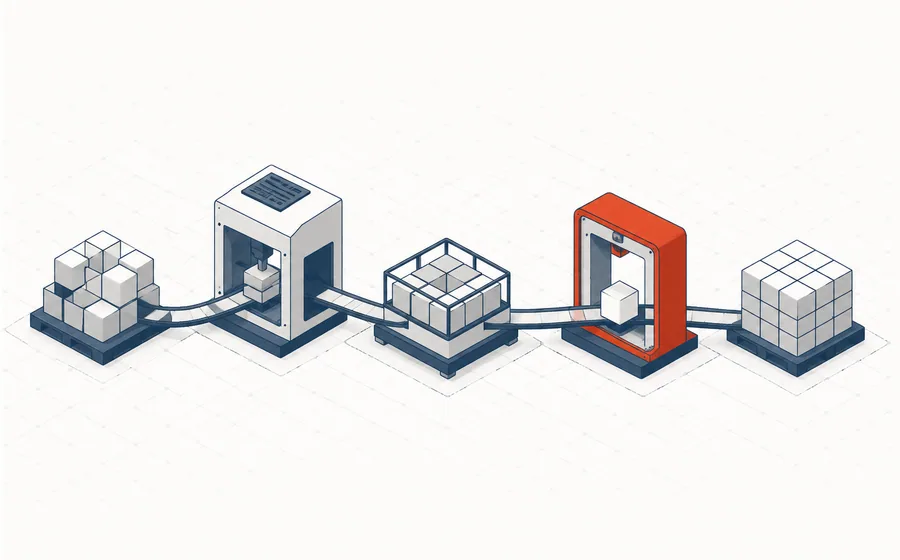
An abstract production flow from raw material through machining, work in progress and inspection to finished goods.

Implementation approach

Manufacturing implementations fail when everything changes at once. This sequence keeps each phase useful on its own.

How we phase it

  1. 1Document the real production sequence, including the job work and workarounds nobody writes down
  2. 2Build product masters, BOMs, routings and wastage norms
  3. 3Go live on material and inventory first, so stock is trustworthy
  4. 4Add work orders and shop-floor recording
  5. 5Layer quality checks onto a working production flow
  6. 6Introduce costing last, once the inputs feeding it are reliable

Integration possibilities

Shop-floor hardware varies enormously and older machines often expose nothing at all. Each is assessed against your actual equipment rather than assumed.

View Easy Khata integrations

Recommended solutions

The capabilities that matter most in this industry, the features inside each, and which product delivers it.

Manufacturing and Production Management

Materials, production, quality and costing connected to the sales and finance side of the business.

  • Multi-level BOM with versions and wastage
  • Production planning against demand and capacity
  • Work orders with assignment and progress
  • Material issue, consumption and WIP tracking
  • Quality checks with defects and corrective action
  • Job work and subcontracting
  • Production costing with standard versus actual
  • Batch, lot and serial traceability

Inventory and Purchase Management

Know what you hold, what it cost and what needs ordering — across locations, batches and units.

  • Real-time stock with low-stock alerts
  • Batch and expiry tracking, and serial-number tracking
  • Barcode scanning for receipt, billing and stock-take
  • Product variants and multiple units with conversions
  • Multi-warehouse and godown transfers
  • Purchase orders, quotations, returns and supplier ledgers
  • Stock valuation and outstanding-payment tracking

Business Management and ERP

One connected system across branches, users and workflows, so operational data is entered once and read everywhere.

  • Connected sales, purchase, inventory and accounting on shared master data
  • Multiple branches, godowns and business locations
  • Users, roles and permission control over what each person can see and do
  • Configurable approval workflows for discounts, purchases and expenses
  • Central master data for products, customers, suppliers and tax rates
  • Consolidated reporting across the whole business or one branch

GST and Compliance

Tax-correct documents at the point of billing, so compliance is a by-product rather than a monthly scramble.

  • GST invoices with multiple slabs applied per item
  • HSN and SAC code management on product masters
  • Cess support where applicable
  • GST reports for return preparation
  • e-Invoice workflows
  • e-Way Bill workflows

Billing and Accounting

Invoices, payments, expenses and ledgers that stay in agreement without a month-end rebuild.

  • GST-ready invoices with multiple formats and print sizes
  • Customer and supplier ledgers with running balances
  • Receivables and payables with ageing
  • Cash and bank accounts with payment tracking
  • Expense recording and categorisation
  • Cash book and business reports including profit insights

Integration opportunities

Connections that commonly matter in this industry. Each carries its own honest status.

Questions

Manufacturing has two answers. Easy Khata runs the business around production and is available today, with every module carrying an explicit status rather than being presented as complete. MANUPRIME is being built to run production itself and is not released yet. Tell us your specific production workflow and we will say plainly which of the two fits, or whether neither does yet.

Talk to us about manufacturing

Describe how your business runs today. We will be straightforward about whether a ready product fits or whether it needs building around.